
What top performers do differently? – Cracking the performance code & inducting for critical task mastery
Executive summary
Corporates in today’s world deploy multiple sales excellence programs to uplift the bottom performers, only to realise that the solution is unsustainable. They engage with global consultants who try to tackle the issue with tried and tested frameworks, which worked in the past. However, the problem is still unresolved, and the lacuna between the top and bottom performers is only compounding. While the bottom performers struggle to meet their numbers, the top performers, who belong to the same cohort, quietly achieve outstanding results. They pull the weight of the entire cohort upwards and are the drivers of business profitability. QP asks one simple question: What are these top performers doing differently?
Context
Consider 2 candidates with identical profiles with respect to education and experience. They get hired into the organisation by the same HR, get trained by the same trainers and work in the same geography against the same competition. They sell the same products and have the same incentive structure. There is nothing that separates the two. Unfortunately, during the annual appraisal, one of them gets a high rating because he/she performed exceptionally well and subsequently get promoted. The other candidate, unfortunately, underperforms, gets demotivated, and ultimately is put on PIP or worse, asked to quit.
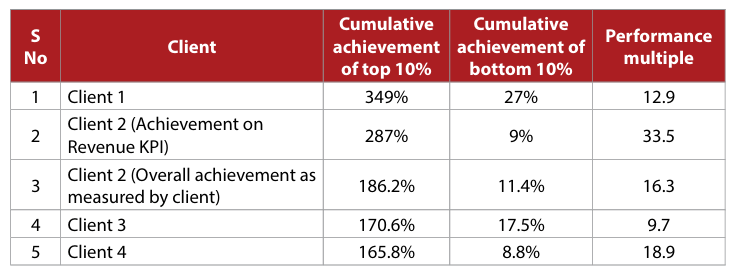
Data reveals stark truths: The performance variation among the top and bottom performers is striking, and this phenomenon is observed across industries. QP’s studies with life insurance, banking, home loans and vehicle loan sales clients indicate that the performance variation among the top 10% and bottom 10% of the cohort within the first year can be as high as 20X. That means that within 1 year of joining the organisation, the top performers are performing 20 times better than the bottom performers.
Why does this variation exist?
When all the factors are constant, why are the top performers achieving 15-20x better than the bottom within the first year of joining the company? In quest of the answer, QP interviewed the frontline from various sectors across all the performance bands. Multiple scenarios, test cases and simulations were presented, and the answers of the cohort were recorded.
Through the interactions with the frontline, coupled with the existing wealth of TMI’s knowledge, QP discovered that the top performers, surprisingly, did only 2 things differently. They identified certain tasks that were critical to the outcome, and they dedicated the bulk of their time to executing these tasks with precision. While the low performers were running helter-skelter, trying to execute everything in their path, the top performers prioritised, focused and delivered. This was the dominant secret of success of the top performers. They work smart and hard. Smart, because they know what to do and hard, because they do it with diligence.
The Role Mastery model
QP developed the patented People Performance Modelling framework to identify the critical tasks that top performers spent their energy on. It is a definitive, logical, mathematical model, deployed to extract the critical tasks in a role. Through this model, every process in the frontline can be broken down into Stages-Activities-Tasks-Subtasks (SATS). The subtask presents the fundamental unit of work performed by the frontline. Typically, a role consists of 100-150 subtasks. To generate 1 outcome of work (for e.g., making one home loan sale), the frontline has to execute all the subtasks. The top performers identified that of all the subtasks, only a handful (around 15) had maximum correlation to the outcome. This is the Pareto principle in real-time motion. They knew what these tasks were and knew how to execute them meticulously. The bottom performers spent their time on tasks which had little correlation to outcome and did not know how to execute the critical tasks properly. Identifying and transferring these secrets of success from top performers is the solution to consistent performance.
Conclusion
The secret to achieving high performance lies within the system. Tapping the potential of top performers and transferring their learnings and secrets to the bottom performers will enhance the performance of the entire cohort. The People performance modelling is a mathematical intervention which provides the degree of correlation between outcomes and critical tasks. This is what separates the top performers from the herd. Hence, induction programs must be redesigned for critical task mastery, which is the secret of success of Top Performers.
To know more contact Akshita Jai Kumar (7032642609) or Srinath Santhanam (8939836636).