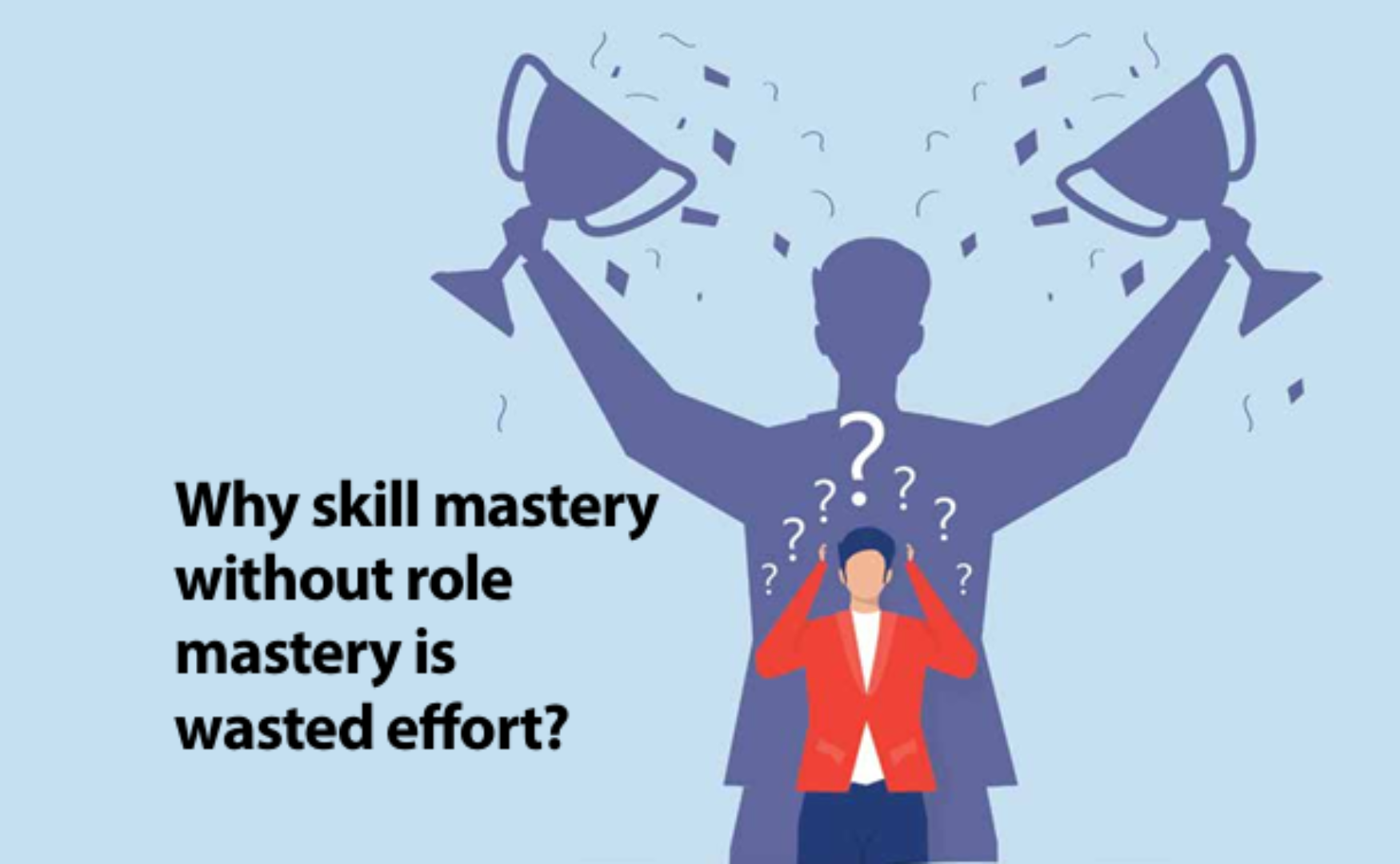
Why skill mastery without role mastery is wasted effort?
Executive summary
Upskilling is everywhere. Certifications pile up, training hours soar, and learning budgets grow. Yet frontline productivity remains sluggish. The reason: skills without role context don’t translate into performance. Training that is generic or disconnected from the realities of the job becomes activity without impact. To truly lift organisational performance, companies must shift focus from skill mastery to role mastery, where learning is directly mapped to outcomes and business priorities.
Context
Across industries, companies are racing to reskill their frontline for a digital, customer-centric world. But the bottleneck isn’t skill shortage, it’s skill irrelevance.
- Insurance example: Agents memorise product features but fail to connect them to customer needs, leading to missed sales despite “knowledge.”
- Home-loan example: Sales reps know financial jargon like “floating rates” or “mortgages,” but lose customers who need simple, clear explanations.
Training without role context creates a dangerous illusion of capability: employees look skilled, but the business doesn’t see results. Multiple studies support this:
- Ericsson (1993): Practice works when tied to relevant tasks.
- Gallup (2022): Gen Z favours practical, purpose-driven learning.
The evidence is clear: context is the bridge between training and impact.
The Quanta People Framework
At Quanta People, we’ve studied top performers across banking, insurance, pharma, and consumer lending. Their edge isn’t just skill, it’s how they apply skills in context. Our approach builds that discipline through:
- Role Mapping Before Training Start with critical subtasks of the role and map skills backwards.
- Lead Indicators Over Lag Metrics Evaluate whether training changes behaviours that predict success, discovery questions asked, follow-ups completed, and complex cases handled.
- Contextual, Limited Learning Journeys Replace broad, generic courses with targeted, scenario-based practice aligned to live role challenges.
- Reinforcement Loops Build daily coaching and feedback into the system so skills stick and translate to measurable performance.
This is how organisations move from “trained employees” to effective employees.
Conclusion
Skill mastery without role context is expensive window dressing. Role mastery, on the other hand, drives measurable business outcomes. For organisations that want sustainable frontline excellence, the path forward is clear: contextualise learning, measure lead indicators, and reinforce what matters most.
To know more contact Akshita Jai Kumar (7032642609) or Srinath Santhanam (8939836636).