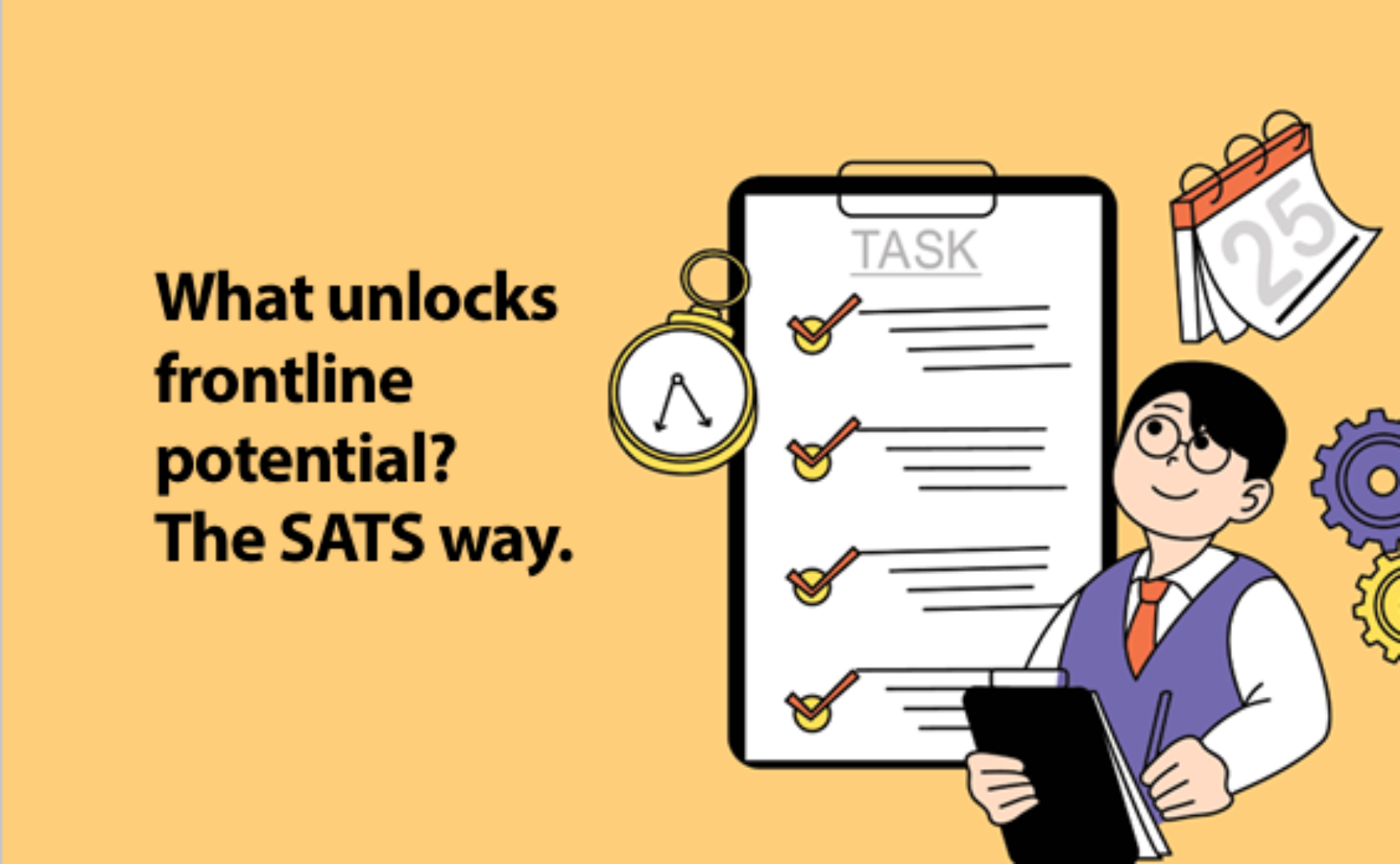
What unlocks frontline potential? The SATS way.
Executive summary
In organisations with large frontline teams, these employees are the real growth engine. They meet customers and sell your products. Yet, most companies still measure them through lag indicators, sales closed, conversions achieved, and incentives paid. These are snapshots of the finish line, not the play-by-play that gets you there. To truly unlock frontline potential, performance must be assessed on lead indicators, the daily actions that predict tomorrow’s results. That’s where QP’s SATS framework comes in. The Stages–Activities–Tasks–Subtasks (SATS) model is a scientific, structured way to break frontline performance into its smallest components, revealing the Secrets of Success that separate top performers from the rest.
Context
At a bird’s eye view, frontline work looks deceptively simple: “sell a home loan,” “onboard an agent,” “close a policy.” But beneath every outcome lies a sequence of actions.
- Each outcome depends on stages (broad phases like lead generation or policy issuance).
- Each stage breaks into activities (shortlisting a customer, planning a pitch).
- Each activity contains tasks (preparing that pitch).
- And each task consists of subtasks, the smallest, observable unit of work (actually delivering the pitch).
This SATS lens transforms vague job descriptions into a transparent map of what frontline work really looks like. A typical breakdown reveals 7–8 stages, 15–20 activities, 40–50 tasks, and 100–150 subtasks, each measurable, coachable, and improvable.
The Power of SATS
Not all subtasks are equal. Across industries, banking, insurance, FMCG, and consumer lending, Quanta People’s research shows that only 20% of subtasks drive 70–80% of success. Top performers intuitively focus on these high-impact subtasks, executing them with discipline and precision. Underperformers either don’t know what these subtasks are or don’t execute them well enough. SATS identifies these leverage points, makes them visible, and converts them into a repeatable playbook. It’s the difference between hoping for excellence and engineering it.
Conclusion
SATS is more than a process map. It is both a mindset shift and a strategic tool. It teaches one timeless truth: performance excellence isn’t luck, it’s the outcome of doing the right things, the right way, at the right time. For companies willing to embrace it, the SATS model is the secret key to unlocking frontline potential, maximising productivity, and building sustainable competitive advantage.redesigned for critical task mastery, which is the secret of success of Top Performers.
To know more contact Akshita Jai Kumar (7032642609) or Srinath Santhanam (8939836636).