

How to use the pareto principle to unlock frontline excellence?
Executive summary
QP’s patented SATS framework breaks down any frontline process into the Stages-ActivitiesTasks-Subtasks (SATS) model. SATS is structured, methodical and breaks down the complex frontline process into its most granular components. Every subtask contributes to the outcome, and all the subtasks need to be accomplished to achieve one unit of outcome. This is where the Pareto Principle comes into play. It states that 20% of the efforts drive 80% of the results. In frontline roles, a small set of subtasks contributes to the success of the process. Top performers know these critical subtasks and execute them with extreme diligence. This is their secret of success. QP applies a scientific methodology to identify these critical subtasks and help organisations to replicate the success of top performers and maximise frontline productivity.
Context
A frontline role may appear straightforward, but in reality, it is made up of multiple stages, activities, tasks, and subtasks. Not all of these carry equal weight. Some are disproportionately critical; they consume more time, cost more to execute, or carry a higher risk of failure if not done correctly. When organisations fail to recognise this imbalance, performance management becomes a blunt instrument. Time and money are spread evenly across everything, rather than concentrated on the few levers that truly decide outcomes. This is where inefficiencies creep in and productivity stalls. Our work across industries shows that a small set of subtasks consistently carries the bulk of impact. These “critical subtasks” often account for the majority of cost and performance variation. For example, in a housing finance client, more than 100 subtasks were identified, yet only about 30 of them explained nearly three-quarters of the total cost. This is the Pareto Principle in action: 20% of the work drives 80% of the outcome. The real difference between top performers and the rest is that they instinctively focus on these critical few subtasks, while others disperse their effort across the many.
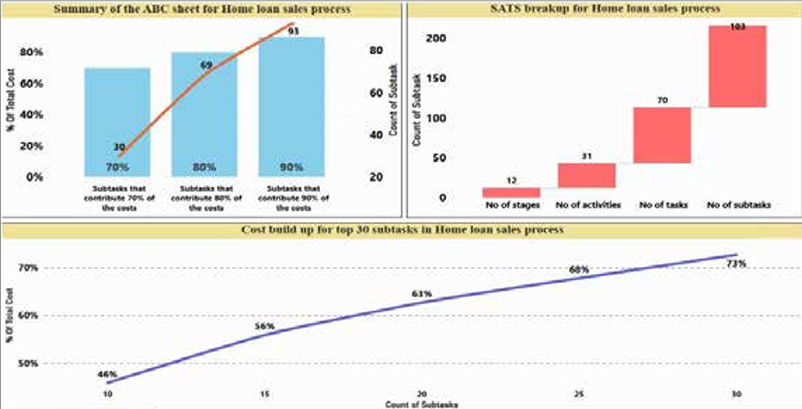
For one of the home loan clients, the entire process was broken down into 103 subtasks. Of the 103 subtasks, 30 subtasks contributed to 73% of the total cost. This is the Pareto Principle in action. The top performers concentrate on these 30 tasks and execute them diligently, and this is their secret of success.
Conclusion
The Pareto Principle isn’t a theory; it’s the frontline reality. A handful of tasks determine the fate of performance, cost, and growth. The organisations that identify this critical 20% don’t just improve efficiency, they redefine outcomes. Everyone else is just busy.
To know more contact Akshita Jai Kumar (7032642609) or Srinath Santhanam (8939836636).